Wednesday, May 8, 2013

Can you make an egg?

When JoAnn was studying art at Eastern Washington College of Education, one of her instructors demonstrated how to make realistic shaped plaster eggs.  She applied this process to create a large 12" long plaster egg that she used as a model to form a mold over.  After removing the plaster egg she used the mold to cast a large blue resin egg with a figure inside.  This was described in my recent post, "Memories of an Art Exhibit" as part of one of the pieces on display.

I decided to include this process in my art work so here are the details.  You will need Plaster of Paris, a small neck container like a wine bottle and a medium sized rubber balloon.  Mix the plaster to the constancy of  medium thick gravy, then pour it into the container.  A plastic funnel makes this transfer much easier.  Now blow the balloon up to the size you want the egg to be and a slight bit more for lost air in the next steps.  Quickly slip the balloon over the neck of the container without loosing too much air.  Invert the container and transfer the plaster into the balloon.  Remove the container and tie off the neck of the balloon.  Gently rotate the balloon while tipping it back and forth so the ends also get coated.  This will take some time until the plaster sets up.  Try hold the balloon in the palms of your hands so as not to make indents with your finger tips.  When you detect the plaster has set and is no longer flowing inside the balloon, carefully set your project down and let it dry until the next day.  The balloon comes off easily if you pull out on the end you tied and start a cut in the rubber.  Usually it will tear itself open as it contracts, leaving a smooth white egg.

At this point the egg is quite sturdy if you have used enough plaster to build an 1/8 to 1/4 inch thick shell.  It will brake if you drop it however.  I chose to coat my egg with hardwood segments in a mosaic pattern and finish it as I have the vessels I make.


This project needed a stand to hold the egg while it was on display, so I fashioned a bulky, free-form stand with a recessed area lined with sheepskin, wool side out.  When placed in the "nest" as I refer to it, the egg snuggled down and I felt was secure enough  to go to an exhibit.  It would need a name so was christened, "Woodpecker Nest".


All went well as it traveled around to different exhibits and was stored in the various homes we moved to, but gradually I noticed some cracking occurring between wood segments.  I filled the cracks as shown here with red resin and refinished the entire egg with a clear finish that would seal moisture out and prevent further cracking.  Now Humpty Dumpty has age marks but no further problems have occurred.  If I had it to do over, I would fiberglass the plaster egg and then apply the wood over that, thus giving a fiberglass shell similar to the vessels I make.

I had fun making an egg.  You should try it sometime.

Sunday, May 5, 2013

Merging Tennessee and Montana

The fragrance of Tennessee Red Cedar has always intrigued me as hard to mistake for any other wood with the exception of Juniper Cedar that grows in Montana.  You may have come in contact with the red cedar from Tennessee, used in hope chests or as closet lining.  The distinctive aroma comes from the oil in the wood and most bugs don't like it, so it prevents them from chewing on your clothing or important belongings.

I grew up in southeastern Montana where Juniper Cesar turned the bland countryside into interesting patches of dark green and sometimes a silver tree.  They tend to grow on the walls of canyons and provided a totally different atmosphere.  I can still imagine their evergreen fragrance on a hot day.  We used the dead limbs and trees for fire wood.  They were dragged up out of the canyon and taken home to our woodpile.  As I remember it now, some good sized logs were cut into firewood lengths and split into smaller pieces.  The Juniper Cedar aroma from the split wood was very similar to the Tennessee wood.  Some of the straight pieces were saved for fence posts that would last many years in the ground. I decided it was time to get these two woods together in one of my e/p vessels.  This vessel has a plastic lining (a tonic bottle) so it can be used to hold liquids.


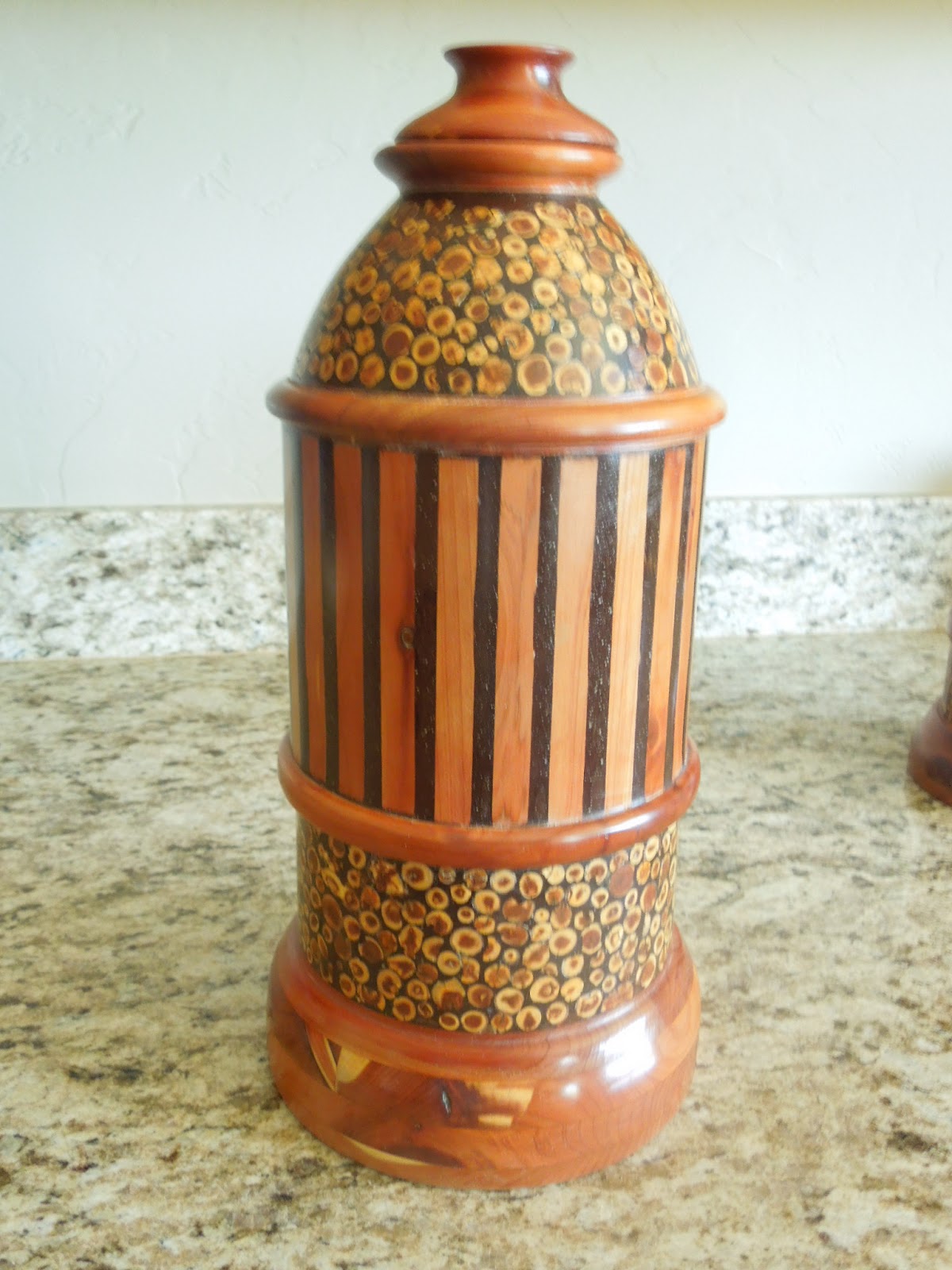
I made two of these vessels over plastic tonic water bottles, one the large 2 liter container and the other a smaller version.  Dimensions of each are as follows:  Large vessel 13.5" tall x 6.5" diameter,  small vessel  11" tall x 5" diameter.  The Tennessee Red Cedar wood was used in the base, central strips and rings as well as the top structure including the removable cap.  The sections of end grain pieces of small Montana Juniper Cedar limbs make up the remaining surface decoration.  In case you are wondering what e/p vessel stands for there is an earlier post that details this.  This last photo shows the relative size of these two vessels.


Black resin holds all the wood pieces in place.  After the surfaces were worked down and sanded smooth, an oil finish was rubbed on and when dry, paste wax was applied and buffed.

Thursday, May 2, 2013

ARCOSANTI BELLS

( a snippet from my autobiography "Growing Up In The Country")


Our friend and my co-worker, Craig invited JoAnn and me to his home in Prescott for a week end.  He had a guest house where we could stay
that offered us all the privacy and comfort of a motel.  Craig suggested we stop at Arcosanti on our way to Prescott and tour that unusual architectural project.  It was just off the main highway a couple of miles.

The route to Prescott is through Phoenix and then north on highway 17, locally known as the Black Canyon Freeway.  Cordes Junction is 55 plus miles up the freeway where highway 69 takes off to the left for another 35 mile drive to Prescott.  To find Arcosanti we continued along side highway 17 another mile past the junction, following a dirt road, which soon turned to the right toward a significant canyon.  Arriving at the edge of the canyon an unusual collection of buildings came into view.  They were built on the crest and down into the canyon.


Arcosanti is an experimental community that began construction in 1970. 
The architect, Paolo Soleri, used a concept he labeled as “arcology”, a combination of architecture and ecology.  He designed the community to demonstrate how urban conditions could be improved through architecture to lessen the negative impact on the environment.  The location of the project is on 25 acres of a huge 4,060 acre land preserve.  When we visited the project it was still considered a work in progress and I would guess still is.  It was designed for a population of 5,000 when finished.  The current number made up of students and volunteers fluctuates between 50 and 150 people.  A massive complex many times larger than the facility we visited, called Arcosanti 5000, was envisioned in his master plan.

The community is building slowly as funding and volunteer help becomes available.  The primary function so far had been education, with students coming from around the world, to study architecture and ecology in workshops and classes.  In addition to the funds raised by education, the students participate in the ongoing construction.  Tourist traffic of approximately 50,000 people per year also creates funds for the project.  Cultural performances are sometimes scheduled in the outdoor amphitheater which draws good sized crowds.  One of the staff I work with told me of a festival held at Arcosanti in 1978.  The large crowd parked their cars in an open, flat area close to the performance and during the festivities a grass fire started, ignited by the hot muffler of one car and quickly spread across the lot.  More than 300 cars were damaged or destroyed.  Unless insurance settled the clams, this may have been a costly festival for Arcosanti.

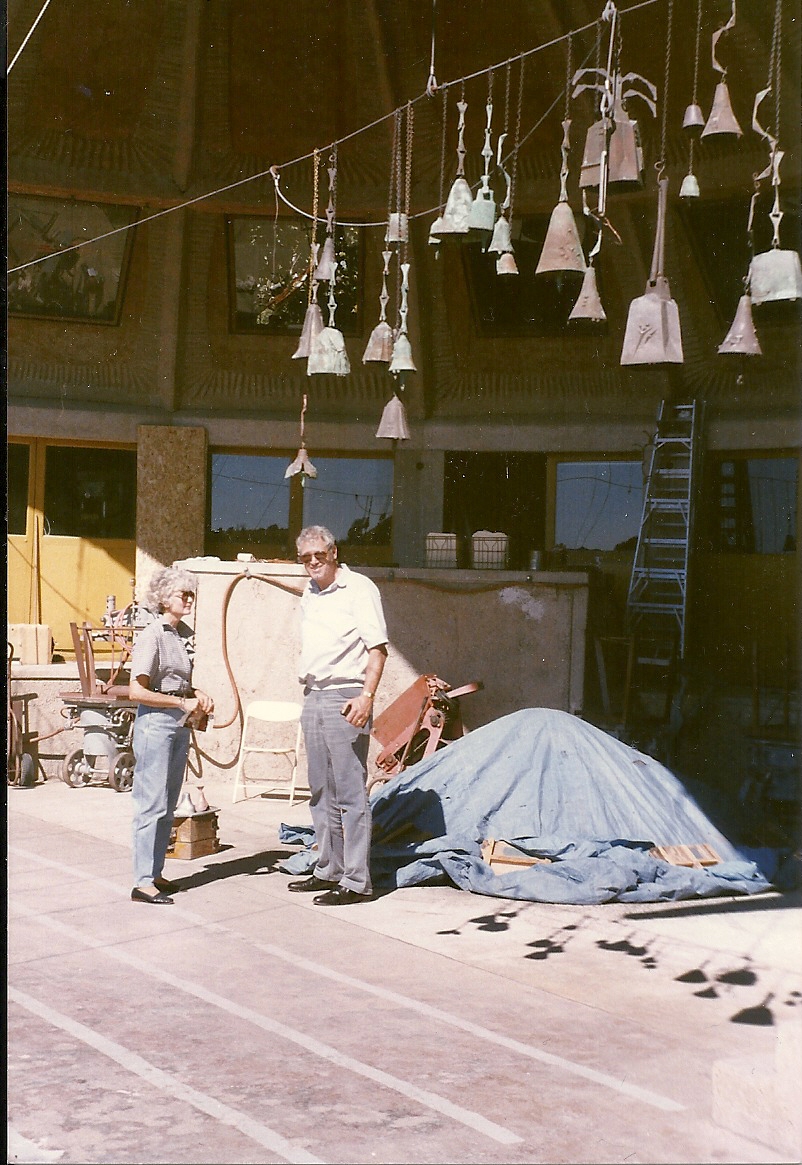
Some funding is generated through the sale of metal and ceramic bells that are designed, made and cast on site.  A small sales outlet and fabricating facility is also located in Scottsdale, at the headquarters of the Cosanti foundation and closer to a larger potential market.  We purchased a ceramic bell at the Arcosanti location.  Later we collected a bronze bell at the facility in Scottsdale.  Their design is distinctive.  They make a good souvenir while helping the community development.


These large shell shaped structures were used as shop space to work on the bells.  I believe this one was where the ceramic bells were made.  The supplies are stored along the back wall in the white containers and the metal drying rack for the green ware is shown there also.


The five story structure housing the visitor’ center, cafe  gift shop and topped with a two bedroom “Sky Suite” available to overnight guests is the tallest point in the complex.


We had to leave for Prescott but vowed we would return when we had more time and possibly stay in that Sky Suite.

Saturday, April 27, 2013

Memories of an Art Exhibit

Some things stick in your head over time and you don't know why.  Let me tell you about my wife's Masters Art Exhibit and maybe you can tell me why.  JoAnn was working towards a Masters in Fine Arts degree from Eastern Washington University in Cheney  while I held an administration position with Spokane Falls Community College.  She had started her college work many years earlier in San Dago, California, completed the BA at Central Washington University while I worked there, and now was completing the Masters which required the creation of an exhibit of her work.  A room in the Administration Building was scheduled in blocks of time for each masters student's work.

When JoAnn and I looked at the space it was a disappointing rectangular room with one side almost total windows.  JoAnn started developing a floor plan that would require some temporary remodeling and sought approval.  When given the green light she enlisted me to help with the carpenter work and heavy lifting.  In short order we had the windows covered with plywood panels.  Free standing display modules, pedestals, and bases placed around the room created a path that would lead the viewers past all the art work.  That represented the weekends labor and I had to get back to my regular job Monday morning.  I left JoAnn with the task of painting all that new wood and preparing the art work to be used.  I was amazed when I next saw the exhibit space.  Everything was a soft white and a number of white canvas screens were placed so that when floor spot lights were shone on sculptural pieces, interesting shadows were cast to enhance the canvases.  Only two of these wood sculptural pieces survived our many moves since that exhibit.  You will notice smudges and cracks  that have occurred as testamentary to their age and travels.

JoAnn laid out the designs of her wood sculpture pieces and gave me sizes so I could construct rough wood pieces that she worked down to a smooth shape and finish. These two have many coats of white shellac.  We used them as decorative pieces around the home, so when a blemish would appear white shellac was the corrective measure of choice.  No telling how many coats were applied.  The taller piece stands at 46 inches while the shorter square one is 30 inches high.

You may have noticed this exhibit was primarily done in white.  In fact, JoAnn had a self  portrait of the artist at work in the studio, all in various textures of white.  Sections of the floor were covered with white crushed rock which kept the public out of some areas and defined the viewing trail.  There were limited splashes of color used to draw the viewers attention.  One such example was a site named "Heir to the Throne".  A shadow cast by a large free form white chair was cast on a large canvas on the wall.  It suggested a very majestic throne.  In the seat of the wooden chair lay a 12"long, clear royal blue resin egg with interior color which appeared to outline a fetus shaped figure.  I'll let you think about that instillation with relation to the title.

This should give you a verbal picture of the exhibit with the exception of two other very important pieces.  I had helped JoAnn build what we called "the volcano".  Construction started with layer after layer of wood rings glued together to form the rough shape.  This was then turned  on my wood lathe to produce the smooth outer surface.  One eighth inch wide vertical slots were cut through the wall of the piece, spaced around it's circumference.  Plastic strips were fit into these openings that protruded slightly above the outer surface and also into the open center area.  The photo of our volcano shows what I have been describing.  JoAnn painted the outer surface transitioning from white on top to a graded blue into black at the bottom.
  Two neon tubes,one red and one blue, were bent to form circles that fit inside the volcano.  They were connected to a transformer inside the cone with an extension cord that plugged into an electrical outlet. we were ready to try our creation.  As you can see in the darkened photo, light from the two neon rings is transferred through the plastic strips to the outer surface.  An unexpected result was the mixing of the light between the two sources, resulting in red on top, violet in the center and blue on the bottom.  The final touch  was to place crumpled aluminum foil in the bottom of the cavity so that when viewed through the opening on top the red and blue light was reflected as glowing embers.

We were concerned about the heat that our volcano generated so constructed a round pedestal, slightly larger than the base of the volcano and approximately 18 inches tall.  A whisper fan was mounted in an opening on the top surface of the pedestal which was open at the bottom and raised several inches off the floor. with short legs, thus providing air circulation to carry the heat away.  JoAnn placed our masterpiece in one corner of the room that offered the limited light to make the neon illumination effective.  I called it our creation for we had collaborated using my building skills and JoAnn's design and artistic skills so it was part of her exhibit.

A few final touches and it would be, " on with the show".  We had put in some very late nights getting everything ready as the opening date raced toward us, so we were pleased to see the end in sight.  JoAnn asked her son,a keyboard player in a band that was performing in the area, to create a tape to play as background music.  He had been by and analyzed the exhibit and was impressed with our volcano.  When we played his tape we were equally impressed with his work.  He used the full range of his synthesizer from soft mesmerizing passages to the rumble and roar of an exploding volcano.  It wasn't hard to imagine the floor was shaking and you had to take a quick peak at the volcano in the corner to make sure lava wasn't oozing from the top.

Finally, opening day arrived and JoAnn played her last trick on the viewing public.  Wine and snacks were provided, so she filled several plastic wine cups with tinted resin matching the color of the wine.  This was done well ahead of the reception so that the resin was well set and the resin odor had dissipated.  These containers of fake wine were set among the real wine filled cups and blended in convincingly.  It was fun to watch the expression on the unsuspecting wine drinker that chose the glass of resin.  They all were good sports and became part of the crowd around the snack table to watch others make the same mistake.  A tension invaded the onlookers when the Art Department Chairman strolled up to the table and chose the resin wine.  The group watched as he moved from one cluster of people to another.  Finally he sampled a sip only to discover he had been fooled.  He moved quietly to an exit and left the resin wine siting on a table.  JoAnn wasn't sure if she would be in trouble with him in the future, but he was quite complementary of her exhibit the next time they met and the wine incident wasn't mentioned.

The show was a success and it established JoAnn as a creative artist as did other projects I would love to tell you about sometime.  There are many good memories of this Art Exhibit, but I will never forget the way it effected the viewers.  Perhaps it was the all white show or maybe the shadowy presentations; possibly the music.  I suppose all these factors caused the viewers to move through the exhibit with subdued whispers, almost as though they were in church.  Once out in the hall- way they found their voices and many intense conversations could be heard about various aspects of the exhibit.                     


Tuesday, April 9, 2013

Thinking outside the box

How often have you been told to think outside the box when trying to solve a problem?  It's good advice when you get stuck and there doesn't seem to be an answer to some pesky problem.  I've also been told that 99% of the time there is an answer if you just back off and view the situation with new perspective.  An illustration of this "thinking outside the box" process is shown below.


Try to think of a way to solve this nine dots puzzle without peeking at the answer on the page below.  The answer that is given is referred to as one possible answer.  You may arrive at a different solution that meets the goal of the puzzle.

An interesting cartoon that delves into the history behind the nine dots puzzle is shown below.  It comes from the Sam Loyd's Cyclopedia of Puzzles.  If you get 
hooked on solving puzzles this might be a good source.

Samuel Loyd (1841-1911), born in Philadelphia and raised in New York, was an
American chess player, chess composer, puzzle author, and recreational mathematician.  Following his death, his book"Cyclopedia of 5000 Puzzles was published (1914) by his son.  His son, named after his father, dropped the "Jr" from his name and started publishing reprints of his father's puzzles.  Loyd was inducted into the U.S. Chess Hall of Fame.  Amazon handles these publications.


Thursday, April 4, 2013

Twisted Sister

Back in the day, as old timers often phrase it, I listened to a good deal of live rock music.  I still enjoy the classic rock but it is difficult to find. My wife, JoAnn, and I were regular groupies at clubs around the Spokane, Washington area, partly because we had a son playing with a band called "Warning," that would perform in the Spokane area occasionally.  The band was excellent and played gigs all over Western U.S. with one expedition into far north Alaska.  They would play songs made famous by notable bands of the day such as Deep Purple, Aerosmith, Buchman-Turner Overdrive, Keith Emerson, The Grateful Dead and Heart, to name a few.

I was fascinated with the creativity that went into naming bands and how they used the name in their promotion.  One of Warning's promotional pieces looked like a road sign with the words, "WARNING-Rock Ahead".  One of the strange band names that caught my attention was Twisted Sister, an American heavy metal band from Long Island, New York. They used elements of Iron Maiden and Judas Priest along with the driving hard rock style of AC/DC.  This wasn't my type of music, but their name and stage appearance prompted me to create a cast resin art piece.

Twisted Sister's aggressive musical style was coupled with a grotesque use of makeup and women's clothing resulting in a very unique product.  The band began in 1972 and continued through 1987.  They returned to the stage in 2006 and are still performing.

I planned a cast resin piece that would reflect the color and flair of members of this band.  In addition I gave the hint of a nun's habit to the shape of the piece, thus presenting the "sister" question of the title by adding a religious reference.  Lines in the lower portion of the casting give a twisting perception to the sculpture.  I had fun developing this art and hope you enjoy Twisted Sister.


Twisted Sister

Monday, April 1, 2013

Baked Apple


In the community of Summer Haven, nestled high in the Catalina Mountains above Tucson, stood a Gravenstein Apple tree.  Records indicated it had been planted over one hundred years ago.  It flourished and grew into a large tree.  The residents of Summer Haven enjoyed the fine fruit it produced year after year.  The stamina of the tree impressed the town’s people and they cared for it during the dry years, pruned it to give it shape and kept traffic and building away from its roots.  One thing that could not be controlled was the forest fire that swept through the town on a dry, windy day.  It burned the heart wood in the trunk and larger limbs,  but the apple tree did not die.  The outer layer of green wood continued to furnish nutrition to the top branches and eventually grew over and around the fire damaged surfaces.  The people were profoundly impressed at the will to live this tree exhibited after being ravaged by the fire and they soon were enjoying its fruit again.

In recent years a second major forest fire raged across the Catalina Mountains burning for days and destroying all that was in its path.  The little town of Summer Haven lost many of the summer cabins and most of the business district.  After the smoke had cleared and the damage assessed, the majority of the residents started to rebuild.  Funds appropriated by the county were designated to construct a community center with 1% of the total allocated for art work.  A committee was formed to establish goals and regulations for use of these 1% funds.  A call went out nationally for artists to submit their proposals for art they could provide at Summer Haven.  A sub committee was soon established by those who felt strongly that the art should relate to the apple tree that had suffered further damage in this fire.  It was still clinging to life but there was doubt about how long it could sustain this fight.  The owner of the lodge on whose property the tree grew planned to rebuild.  He had given notice he would have to remove the tree when construction started.  The sub committee wanted to incorporate the tree in the community center design.  This concept was of interest to our Apatchablue Studio, so a proposal was drawn up and JoAnn and I started attending meetings of the committees.  JoAnn developed a sketch of a large wall relief of an apple tree constructed with apple wood from the Summer Haven tree.  If accepted we planned to develop it in more detail.  We received word that our proposal was one of three chosen.  One of the other artists was local and the other was from the east.  We were all invited to meet with the committee and give more detail on what we planned to do.  The committee would also give us a timeline for the work and an idea of funding.  We were invited to travel to Summer Haven to view the area of the proposed community center.  While there we got a first hand look at the apple tree.  It was a pathetic sight but still had some green leaves in the top.

The local fire crew was called to cut off some dangerous limbs and low brush.   The sub committee lobbied for major visibility of the tree.  They wanted it brought into the main lobby of the community center and dismissed our plan to build a  wall relief tree from wood gathered from the old tree.  The architect working on the plan for the building was against having the actual tree placed in the lobby and we agreed with him that the it wasn't a beautiful thing and much too large for the space.  He suggested we explore decorating the front of the reception desk with the apple tree design.  He gave us information about the size and composition of the reception desk, so we were back at the drawing board.

The situation was becoming frustrating as time went on and the two committees battled back and forth over the treatment of the tree.  In the meantime we were given a pickup load of the apple wood trimmed from the tree, so that we could develop a mock-up of the decorative treatment of the reception desk.  JoAnn had developed a sketch of this plan and indicated what price we were asking for the work.  I was busy fabricating the mock-up which took several weeks.  When we were ready for our “show and tell” session with the committees we gathered copies of our proposal and the mock-up, and after a rehearsal headed for the meeting.  It went well and the committee asked us to wait outside while it was discussed.  The final outcome was, they liked the idea, but the money was the problem.  They were also searching ways to fund the art of the other artist’s proposals.  An auction night was one fund raising idea scheduled to occur in the next month.  I agreed to make wooden apples from the apple wood we had gathered from the tree, to be auctioned off that night.


 Mock-up of counter

It eventually became obvious that Apatchablue Studio would not be offered a contract to develop our ideas.  We kept the Summer Haven apple tree wood and  " Baked Apple" was the first vessel fabricated with it.  Slices from a unique section of a limb, showing the burned surface and the subsequent growth around it are the featured design on both sides of this vessel.  Baked Apple was accepted in the 18th International Society of Experimental Artists show in Bethlehem, PA., starting on 8/29/09.  Unfortunately I broke my hip and wasn't able to pack and ship the piece to the show.  The only other show this vessel has been viewed in was the Annual Members Juried exhibition at Tubac, Arizona.  The Tubac Center for the Arts selected Baked Apple for their 2009 show starting 11/20/09.  Additional pieces will be developed in the future using this Summer Haven apple wood.  Baked Apple is now a part of my pilot son's collection.  He flies for Western Airlines.


Baked Apple